
Monterey County Court Records After Arrest
Monterey County Superior Court describes the local sequence in direct terms. A crime is reported, an officer may arrest the suspect or cite and release the person, and the officer sends a police report to the Monterey County District Attorney's Office. The prosecutor then reviews the report, witness statements, and prior criminal or DMV records before deciding whether to file charges. If the person was booked into Monterey County Jail, the jail record is the custody side of the event. The filed complaint, indictment, hearings, and disposition are the court records after a jail arrest.
Sheriff Tina M. Nieto oversees the Monterey County Sheriff's Office, including the jail system that houses adults after local arrest. The sheriff's in-custody log can help confirm that a person is or was held in the jail, but it is not the court case file. The custody row belongs with Monterey County jail inmate records, while booking-photo limits belong with Monterey County jail roster mugshots. Court records after a jail arrest belong with Monterey Superior Court, where the case status, filed charges, hearings, and final outcome are tracked after filing.
Monterey County Arrest to Complaint
The local court pathway is not instant. A person can be arrested, booked, fingerprinted, photographed for law-enforcement use, and listed on the current jail roster before a filed court case exists. The Monterey Superior Court Criminal Division says adult felony and misdemeanor matters are processed in the Salinas Division, and the District Attorney may file a criminal complaint in Salinas regardless of where in Monterey County the offense occurred. If the person remains in custody at Monterey County Jail, the court clerk page says the person may be held up to 48 hours excluding weekends and holidays while the prosecutor decides whether to file.
That 48-hour window explains why early search results can conflict. The jail roster may show alleged booking charges from an arresting agency, such as a city police department, the Sheriff's Office, Probation, Parole, or Superior Court. Later, the prosecutor may file different charges, amend a count, decline a count, or charge a lesser offense. Court records after a jail arrest should be read by case stage, not by the first charge text that appears in a jail row.
Process flow: Arrest or citation - booking or release - police report to the District Attorney - charging decision - complaint or indictment - arraignment - hearings - disposition.
Monterey County Court Case Search
The main public lookup route is the Monterey Superior Court public case-search portal. The portal provides case-number, party, business-name, and filing-date searches. Criminal electronic information is available from November 1992 forward, while older violations require the Salinas Courthouse Clerk's Office or the CR-109 record-search and copies process. Remote public access is strongest for indexes, calendars, registers of action, case information, parties, hearings, events, and printable views. Criminal detail tabs may exist in the system, but public access varies, so the portal should not be treated as a promise of every document or secured charge tab.
The Monterey Superior Court Criminal Division page is also useful because it explains the DA review path after arrest. For public case copies, the criminal court records access page directs users to portal search, in-person clerk searches, mail requests, and CR-109. When a person has just been booked, check both systems in sequence: the jail roster for current custody, then the court portal for the filed case after the prosecutor acts.
| Search Field | Type | Required | Notes |
|---|---|---|---|
| Case Number | Text | Yes for case-number search | Minimum 5 characters; wildcard tip appears in portal guidance. |
| First Name | Text | Yes for party search | Minimum 4 characters; use with last name for defendant searches. |
| Last Name | Text | Yes for party search | Minimum 4 characters; wildcard searches can use an asterisk. |
| Business Name | Text | Yes for business search | Used for business-party searches, not ordinary defendant-only searches. |
| Filing Date From / To | Date picker | Optional | Filing-date searches have a maximum five-day range. |
| Courthouse | Dropdown | Optional | Options include All Courthouses, Monterey, Salinas (Criminal), and Marina. |
| Filter Table Results | Text | Optional | Filters visible result rows after portal results load. |
The Monterey Superior Court public case-search portal shows the interface used for Monterey County court records after a jail arrest.
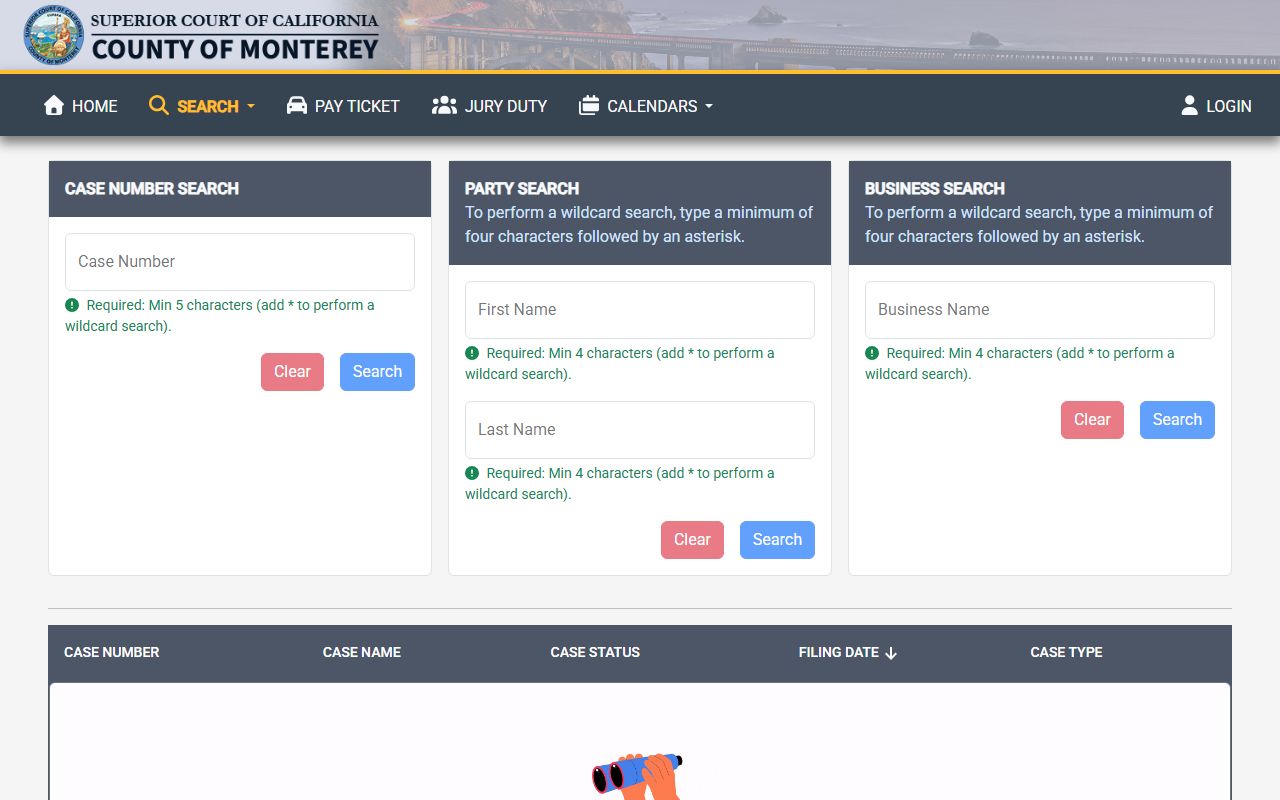
The search fields are useful after a complaint has been filed, but they do not replace the jail's in-custody log during the first hours after booking.
Monterey County Charging Documents
Court records after a jail arrest revolve around the charging document. In Monterey County, the routine adult criminal path is a prosecutor-filed complaint in Superior Court. The court also recognizes indictments, which come from grand jury review. A City Attorney can enforce municipal code within city limits, so some city-code cases may not follow the same DA-only path as most county felony and misdemeanor filings. The public should read each document as an allegation at that stage, not as proof that the person committed the crime.
| Document | Who Files It | Common Use | Public Record Point |
|---|---|---|---|
| Complaint | District Attorney or City Attorney when authorized | Routine felony, misdemeanor, and local-code filing path | Starts the court case after prosecutor review. |
| Information | Prosecutor after required felony proceedings | Some felony prosecutions after preliminary-hearing stage | May replace or follow an initial complaint. |
| Indictment | Grand jury process presented by prosecutor | Less common serious-case path | Grand jury proceedings are confidential unless an indictment is filed. |
The filing document may use a different count list than the Monterey County Jail roster. That is expected. Booking charges can reflect the arresting officer's basis for custody, while filed court charges reflect the prosecutor's legal decision.
Monterey County Charge Status
Once a case is filed, each count can move in a different way. A single arrest may lead to one case with several counts, and some counts may be amended, reduced, dismissed, or resolved by plea while others remain pending. Court records after a jail arrest should be checked for both case status and count status. The roster's CHARGES field may include felony or misdemeanor prefixes, short descriptions, and occasional dollar amounts, but it does not show final disposition or full court history.
| Status | Plain-English Meaning | Why It Matters |
|---|---|---|
| Pending | The count or case has not reached final outcome. | No conviction should be inferred from the charge alone. |
| Amended | The prosecutor or court changed the count language, code, or allegation. | Later court records may not match the first jail charge. |
| Reduced | The charge moved to a lesser offense or lower level. | The case history may show both the original and reduced count. |
| Dismissed | The count ended without conviction on that count. | A dismissal is not the same as a guilty finding. |
| Disposition | The final outcome of a count or case. | Disposition is the key term for resolved court records. |
Monterey County Bail and Court Release
Monterey County bail information can appear in more than one place, but none of the early sources should be read alone. The Sheriff's jail information page links to online bail payment and lists Pay Location Code #6519, while the public in-custody log sometimes shows dollar amounts inside the CHARGES text. Those charge-line amounts are not a full bond field. They do not show whether a no-bail order, probation hold, parole hold, bench warrant, ICE detainer, or other agency hold blocks release.
The court, not the roster, controls court-set bail and release conditions. Monterey Superior Court describes release paths after booking that include release if charges are not filed within the required time, own-recognizance release with a future date, release after bail, and Pretrial Services Own Recognizance or supervised release. A practical search should collect the booking number, case number if filed, arresting agency, and charge text before calling the jail or checking the court record.
Monterey County Warrant Records
The official warrant picture in Monterey County is not a public active-warrant list. The Sheriff's Records Division says it maintains all criminal, traffic, and juvenile warrants issued in Monterey County, but release of warrant information is limited. The Sheriff's Warrants Division enforces bench warrants from Monterey Superior Court, serves restraining orders, handles evictions, and collects money judgments. Questions route through the Sheriff's main number, 831-755-3700, or through court channels when the concern is a court date.
Failure to appear is a key local issue. The court clerk page warns that missing a hearing may lead to a warrant for immediate arrest, and clerks cannot continue or postpone court dates for callers. A person with an outstanding warrant remains subject to arrest even if a future date appears on a calendar. The court portal may show case status and hearings, but it should not be described as a public warrant database.
Monterey County Court Charges
Two comparisons keep Monterey County court records after arrest in context. First, a charge is not a conviction. Second, sealing or dismissal relief changes public access in specific ways, but it does not always erase every trace from every agency system. California law provides routes such as Penal Code section 851.8 for factual-innocence arrest-record sealing and destruction, and Penal Code section 1203.4 for certain post-probation dismissal relief. Eligibility depends on the case and court order.
| Point | Charge | Conviction |
|---|---|---|
| Stage | Formal accusation filed in court. | Final finding by plea, verdict, or judgment. |
| Proof | Based on prosecutor filing and probable-cause standards. | Requires guilty plea, no-contest plea, or proof beyond a reasonable doubt. |
| Record meaning | Shows what was alleged after arrest. | Shows the legally resolved result for a count. |
| Point | Sealed | Dismissal / Expungement Relief |
|---|---|---|
| Public visibility | Qualifying records are hidden from ordinary public access. | The conviction may be set aside or accusations dismissed under the order. |
| California examples | Penal Code section 851.8 factual-innocence relief. | Penal Code section 1203.4 post-probation dismissal relief. |
| Limits | Law-enforcement or court access may remain in limited settings. | Relief does not erase all consequences or every agency record. |
Monterey County CR-109 Records
When the public portal does not provide enough detail, the CR-109 Request for Record Search and Copies form is the official Monterey Superior Court route for criminal record searches and copies. The form asks for attorney or party contact information, case number if known, searched name, date of birth, driver's license, filing date, disposition date, approximate filing period, whether the defendant was a juvenile at the time of offense, documents requested, certification choice, and delivery preference. The court does not conduct criminal record searches by phone.
Published CR-109 fees include a $15 record search per name, $0.50 per page, $40 per certified document, and $10 off-site retrieval. In-person clerk searches are available at the Salinas Courthouse, but more than three searches or off-site files may take up to 72 hours. Mail requests go to Superior Court of California, County of Monterey, Attention: Records, 240 Church Street, Salinas, CA 93901, with checks or money orders by mail. Processing can take at least 10 days.
The Monterey Superior Court criminal records page shows the official court copy and record-search route for Monterey County criminal cases.
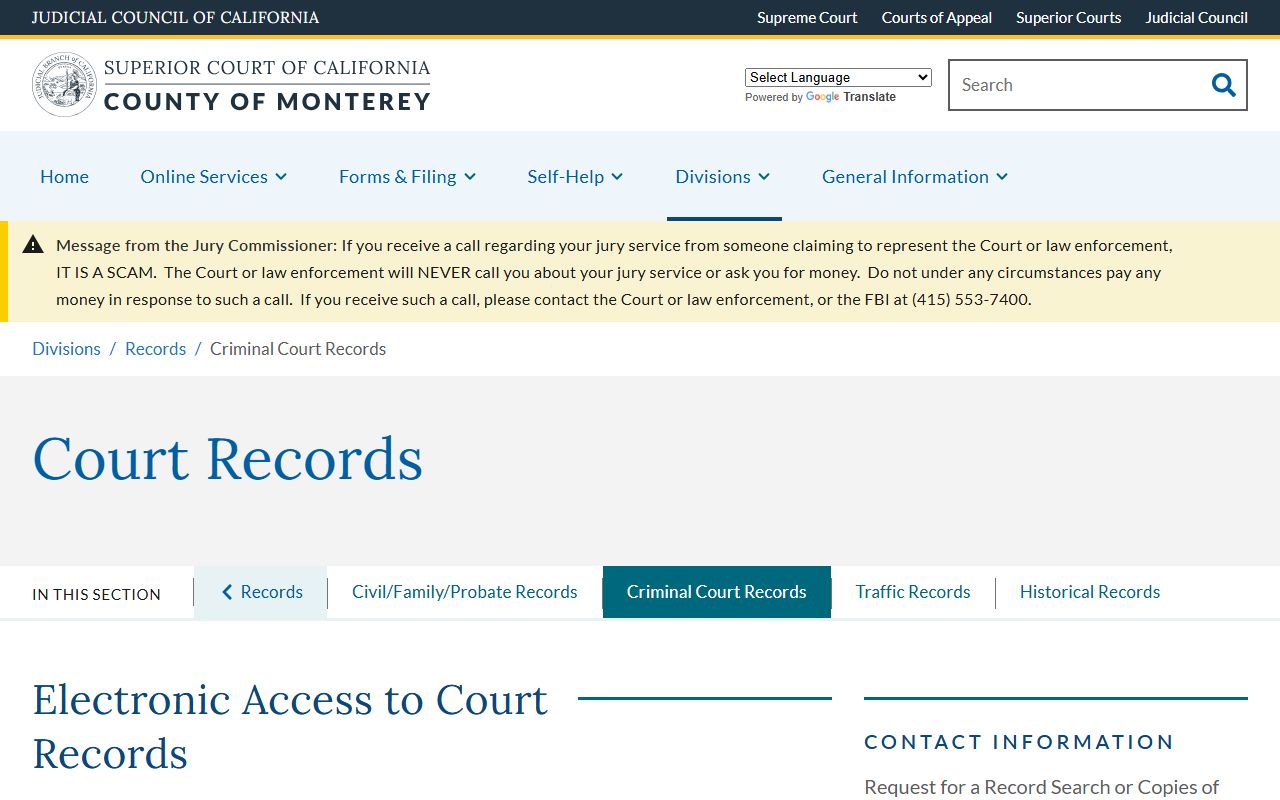
Use the court records route for filed-case documents, and use the Sheriff's Records Division or Sheriff NextRequest portal for booking or arrest records maintained by MCSO.
Monterey County Public Access Limits
California public access law supports many jail and court searches, but it does not make every record remote or unrestricted. Government Code sections 7922.525 through 7922.535 establish the Public Records Act baseline for agency records and response timing. Government Code section 7923.610 requires law-enforcement agencies to disclose specified arrest and booking information unless safety or investigation limits apply. Juvenile records, sealed cases, restricted warrants, protected victim information, and secured court tabs may still be withheld or redacted.
For victim-related help, the Monterey County District Attorney's Office lists a Victim Assistance Program that includes criminal justice process information, notification of criminal justice events, inmate-release notification, restraining-order help, restitution help, and victim impact statement assistance. District Attorney Jeannine M. Pacioni's office is separate from Sheriff Tina M. Nieto's jail operations, but both offices can appear in the records trail after a Monterey County, California jail arrest.
Important: Complaint filing is not proof of guilt. Verify court records with Monterey Superior Court before relying on charge status.